 The Chinese began making porcelain in 25CE. The methods for making it were kept a secret for a long time and porcelain became a major export for China and a major source of its wealth. Today this process is no longer a secret and porcelain is made in many different places—but the use of the word “China” to describe porcelain is a tribute to how important this art form was to them.
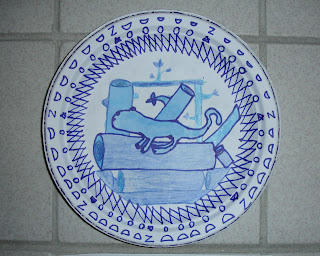
Fifth Grade students examined blue and white china. We focused our attention on a very popular blue and white china design—the Blue Willow pattern. The design itself looks Chinese but students learned this was actually designed in England as an imitation of Chinese examples. In order to sell more plates the designers wanted people to believe this was authentically Chinese so they developed a story to go along with the image in the center of the plate- which was described as a traditional Chinese legend. After reading the story and studying how it was illustrated on the plate students set out to design their own “China”
Students created patterns around the borders of their plates using lines, their initial and geometric shapes. In the center of their plate they illustrated a story based on their own personal experiences.


 Second Grade students studied the work of Alexander Calder. We learned how Calder was very inspired by animals and their movements. In fact, he often visited the zoo to sketch the live animals. Calder also enjoyed the animals and movements he saw when visiting the circus and it gave him an idea for his art...Calder's circus! (video above). Students also decided to draw inspiration from the circus. Each student drew their own circus animal based on a photograph they were given. We learned how to draw an animal by looking at it shape by shape. Once the drawing was complete their images were cut up and we attached them together to make it look like a circus train. On the top of the train studets designed a shape that has symmetry.


