Search This Blog

Wednesday, May 6, 2015

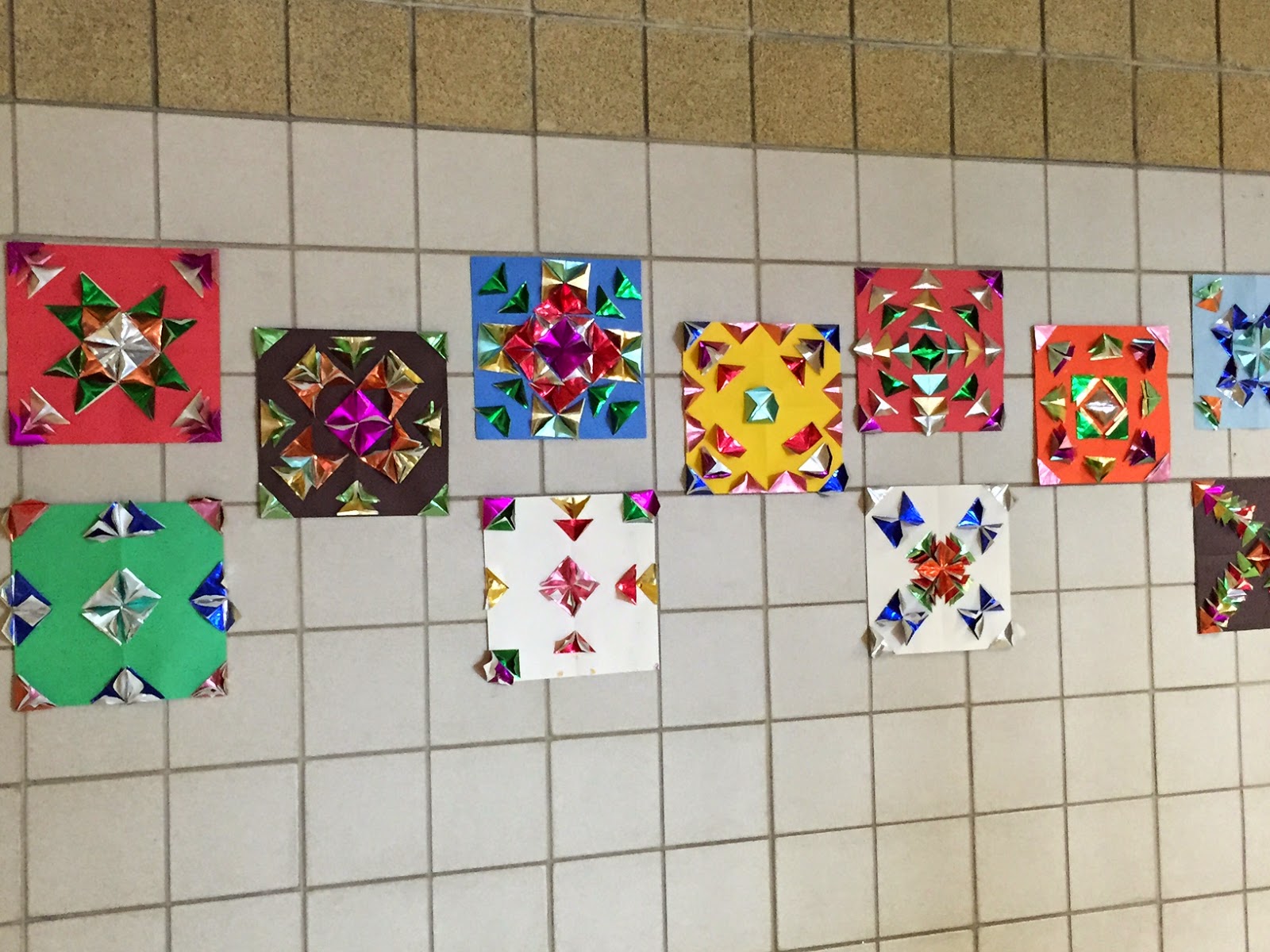
Kaliedoscopes


Third grade students had a brief introduction to the art of paper folding- or origami.  After learning a little bit about this Japanese art form students started learning how to create their own basic origami fold.  After folding a large collection of colors students were then introduced to the idea of rotational symmetry by studying the beautiful designs created inside a kaleidoscope.  Each student then used their collection of origami pieces to create their own kaleidoscope design that demonstrates rotational symmetry.

Bubbles!


Fifth graders tried their hand at drawing bubbles.  Students attempted to draw from imagination but the bubbles didn’t quite capture the real thing. Next, we really examined the properties of a bubble by studying images of them and even looking at real bubbles as they floated around the art room.  We noticed all bubbles have the following qualities:

1.       They have a mix of colors inside them

2.       They are translucent

3.       They have a bright white reflection from the light

4.       The color inside flows with the contour (outline) of the bubble

Students then used their observations to draw a more realistic bubble!


Wild Things


First Graders read the story Where the Wild Things Are by Maurice Sendak.  We then examined the illustrations and noticed that the Wild Things resembled many different animals.  Using this as inspiration, students drew their own wild things.  We then examined the textures we found in the illustrations and compared them to the textures of different animals.  Students discussed the difference between an actual texture and a visual one.  We discussed how to use lines and shape to create our own visual textures that reminded us of different animals.  After applying textures to their work students used watercolors to add color to their creature!


Eric Carle Spiders

Kindergarteners worked together to explore color mixing, creating their own secondary colors.  Once the colors were mixed students added textures by scraping into the fresh paint.  Once the paintings were complete we turned our attention to the work of author/illustrator Eric Carle.  Students read his story The Very Busy Spider.  We discussed how Carle also creates his own colors and painted papers.  He then uses these painting to create the images for his books by cutting them up and collaging them together.  Students used their paintings to collage together their own busy spiders like Eric Carle!!

Hockney Underwater Portraits


No artist captured the thrill of the quick plunge, or leisurely submersion, quite like David Hockney.  He was born in England in 1937  and ended up moving to California in the early 60s- which started his infatuation with swimming pools.  He was inspired to create a series of paintings of swimming pools which was fuelled by the sea, sun, colors and a certain form of luxury. The Californian swimming pool remained one of his main painting themes ever since.   After viewing various examples of his work and inspiration students set out to create their own pool pictures in the form of an underwater self portrait.  Students colored their portraits using oil crayons and then applied a water color resist to fill in the water.


Terracotta Warriors


In 1974 a chance discovery took the world by surprise.  What was found were lifesize clay terracotta  figures…but not just a few- over 8,000!  In sheer numbers and scale, the terracotta army is a remarkable achievement. Artistically and technically it stands alone in the arts of China


Every single soldier is unique, no two are alike, their facial expressions, hair style, posture, height and uniform, all denoting their position and rank within the army.  Fifth Graders discussed and examined this amazing discovery and then created their own warriors using model magic.  Check out our army!


Thursday, December 11, 2014

Egyptian Death Masks


The  Ancient Egyptians were extremely religious people and had very elaborate burial rituals, as well as complex beliefs about life after death.  According to Ancient Egyptian myth, death wasn’t the end of life– it was just a process that every soul must go through in order to reach the next level of eternal life (the afterlife).

In order to achieve eternal life, they believed you had to preserve the dead body. This was accomplished  by mummifying it.  The mummy would then be placed inside the tomb with other vital items that they thought they would need in the afterlife.  Mummies were also accompanied by the death mask.  This gave the dead a face in the afterlife, protected the face and helped to ensure that the spirit could find the right body to return to.  Students discussed the amazing discovery of King Tutankhamen’s tomb and examined the solid gold death mask that was found on his mummy. 

Next students set out to design their own death masks.  Using a mask mold each student  used papier mache to create their own mask.  The headdresses on many Egyptian masks showed images of Egyptian myths and gods.  On the student headdresses they needed to include symbols that could represent the things that are important to them.